The New Diplomatic Balance
The dynamic role of Field Marshal Asim Munir and the Prime Minister Mr. Shehbaz Sharif government in Pakistan's foreign policy.
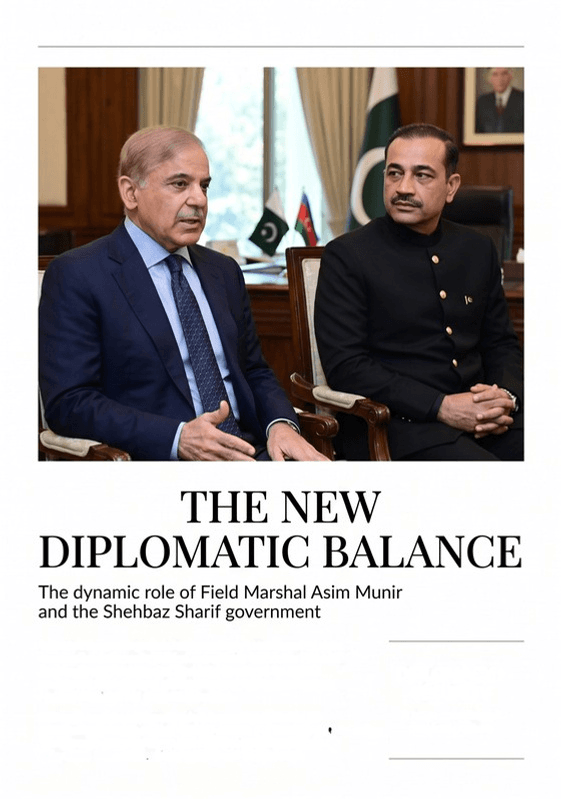
Pakistan's diplomatic posture has increasingly been shaped by close coordination between its political administration and military leadership. This unified approach aims to strengthen national security while expanding the country's economic and strategic footprint globally.
Prime Minister Shehbaz Sharif, General Syed Asim Munir, and the federal government have engaged robustly with regional and international partners during a period of heightened geopolitical tension. Through strategic dialogues, the administration has prioritised bilateral investments and regional de-escalation. The state's emerging international framework tightly links traditional political decision-making with modern security policy, so that foreign diplomacy directly enhances internal stability and regional peace.
Two Centres of Decision-Making
Prime Minister Shehbaz Sharif and the federal cabinet represent Pakistan's primary political and diplomatic decision-making structure. Field Marshal Syed Asim Munir has become a pivotal figure in strategic and security engagement, particularly where regional stability and cross-border dialogues intersect.
The true significance lies not simply in individual high-level meetings, but in the institutional synchronisation between foreign outreach, national security considerations, and broader strategic objectives.
The significance lies in the coordination between diplomatic outreach and strategic security policy.
A New Trilateral Dimension: Pakistan + Türkiye + Saudi Arabia
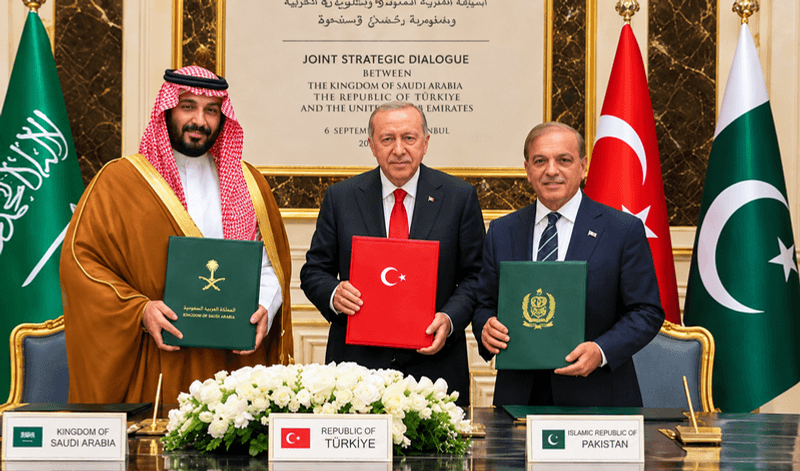
A key milestone was the establishment of a new trilateral defence cooperation framework in August 2026, aimed at enhancing joint R&D and interoperability. Reuters reported that the first Strategic Political and Defence Committee meeting was held in Istanbul on 31 August 2026.
Pakistan's relationship with Türkiye extends across trade, defence, political cooperation and regional diplomacy. In 2026, high-level engagement continued as Islamabad and Ankara worked to deepen their strategic partnership — a relationship that has become increasingly relevant as Pakistan balances its engagement with Saudi Arabia, Iran, China, the United States and other partners.
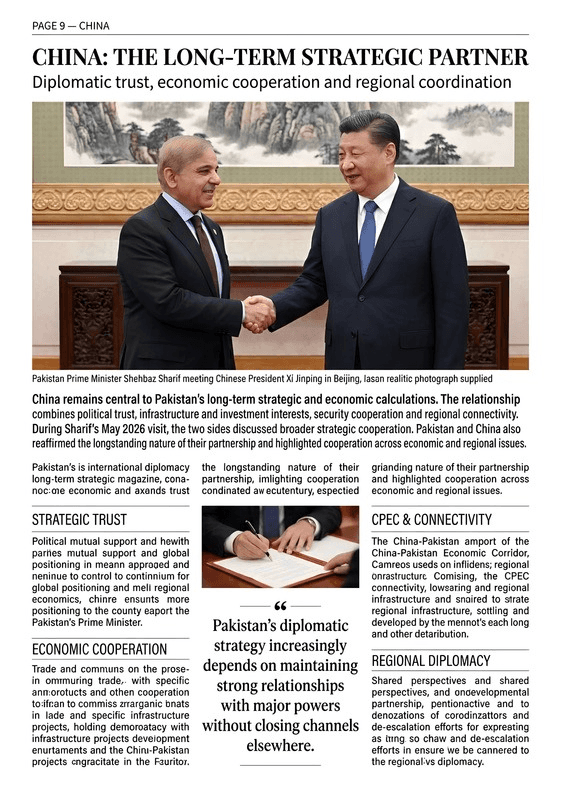
The China–Pakistan Economic Corridor (CPEC) remains central to regional infrastructure. Optimising CPEC connectivity lowers regional trade barriers and develops economic pathways for both nations. Trade and commerce form the foundation of bilateral relations, with specific commitments to finance structural investment projects and joint ventures in infrastructure development.
What Is at Stake?
- National interest — the primary driving force behind maintaining balanced relationships with competing global powers.
- Regional stability — directly impacts domestic economic growth and long-term security across neighbouring borders.
- Economic security — diplomatic considerations can move economic security in entirely different strategic directions.
- Diplomatic access — continuous diplomatic access gives national actors the tools they need to navigate complex global friction.
Continuous institutional collaboration ensures balanced alignment on common security interests and regional foreign policy. De-escalation and preventative diplomacy in the region serve as the foundation for broader Middle East stability, alongside efforts to expand trade, investment and development projects across vital economic sectors.
Dialogue, Diplomacy and De-escalation
Pakistan's present foreign-policy position attempts to balance two objectives that can appear contradictory: supporting peaceful settlement and retaining the ability to defend sovereignty and national interests. The diplomatic message is therefore not one of unconditional accommodation — it is closer to a principle of engagement: dialogue where possible, negotiation where necessary, and firmness where core national interests are concerned. Pakistan's official messaging in 2026 has paired calls for peaceful dispute resolution with explicit support for sovereignty, territorial integrity and international law.
Pakistan has sought to use its diplomatic relationships to keep communication open during periods of serious regional tension. Rather than positioning itself solely as a participant in disputes, Islamabad has increasingly presented itself as a facilitator capable of maintaining contact with multiple sides. Its engagement with both regional and international actors has created diplomatic space for discussion, particularly around the Iran–United States confrontation and wider regional stability. Pakistan's Foreign Ministry describes its 2026 role in the US–Iran process as “facilitative”, including sustained contacts and the Islamabad MoU.
Pakistan's diplomatic posture is not limited to bilateral relationships. Islamabad has repeatedly emphasised the importance of multilateral institutions, particularly the United Nations, international law and collective approaches to peace and security. In 2026, Pakistan's leadership continued to publicly support the central role of the United Nations and the principles of the UN Charter, linking peace and security with development and human rights.
A Peacekeeping Record
Pakistan's peace-oriented diplomatic identity also draws on a long record of participation in United Nations peacekeeping. Pakistani personnel have served across some 48 missions, contributing military, police and other capabilities to international efforts aimed at restoring stability and protecting communities. The UN describes Pakistan as one of the largest and longest-serving contributors to UN peacekeeping — a role central to its foreign policy.
A peace-oriented foreign policy does not remove the need for national security. Pakistan's current position attempts to maintain both elements simultaneously: supporting dialogue and de-escalation while preserving the ability to protect sovereignty, territorial integrity and national interests. Official state policy explicitly pairs peaceful dispute resolution with deterrence, self-defence and strategic stability.
The opportunity is significant. Pakistan's relationships across the Gulf, Iran, Türkiye, China, the United States and wider international institutions give it access to multiple diplomatic channels. But diplomatic visibility does not automatically translate into lasting influence. The long-term test will be whether Islamabad can convert high-level engagement into durable communication, practical agreements, reduced tensions and greater regional stability. Pakistan's Prime Minister said on 1 September 2026 that the country had acted as an “honest and sincere mediator and facilitator”, linking its efforts to the Islamabad MoU and peaceful dispute resolution.
Pakistan's diplomatic influence will ultimately be measured not only by whom it can reach, but by what dialogue can achieve.
Editorial Standards & Transparency
Our Editorial CodeThis article was commissioned, edited, and fact-checked in accordance with Vision News’s editorial policies. Commercial partners and advertisers do not review or influence our reporting. If you believe this piece contains a factual error, please notify our corrections desk at hello@visionnews.uk.